Oppo F9 Pro Review

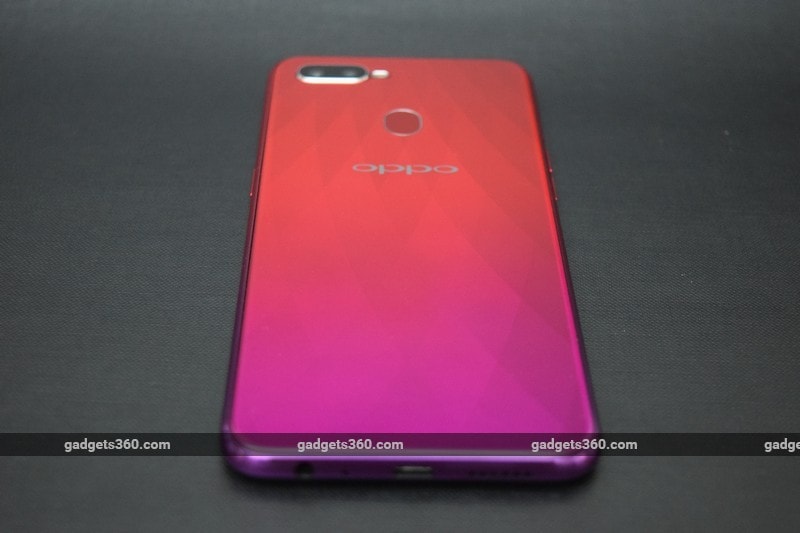

The Oppo F9 Pro₹ 21,398 is a phone for those who want to be noticed. In a world of increasingly generic-looking phones, and manufacturers all racing to copy the same design cues, Oppo has decided to be a little different. The F9 Pro is instantly noticeable and recognisable, no matter which of its three very different finishes you choose - and no, there is no sober, low-key option. If you want something that will work unobtrusively in a corporate environment, or if you don't like getting curious glances when you're out in public, there are plenty of other smartphones that will suit you better.
While looks will be the primary consideration for buyers, Oppo is prioritising fashion as well as features. There's a new, more subtle notch; the promise of excellent battery life plus quick charging; and of course Oppo's usual emphasis on selfies. All these things combined might earn the F9 Pro a few fans - and it needs to play up every advantage it can draw on, now that the Poco F1₹ 20,999 (Review) has completely rewritten the rules of the Rs. 20,000 - 30,000 price bracket.
Oppo F9 Pro design
Unlike most phones these days, the emphasis here is on the back. Oppo has come up with three extremely eye-catching finishes for the F9 Pro, all of which are multi-coloured, patterned, and shimmery. The Sunrise Red finish, which you can see on our review unit, has a gradient of rich, deep crimson and violet, with a swirly diamond pattern. The Twilight Blue option has a similar pattern but the colour runs from dark navy to light blue - it's amusing to think that this is the most low-key. Finally, Starry Purple has a mangenta-indigo gradient with light speckles scattered randomly across it.
All three have an iridescent metallic finish, and at least on our Sunrise Red unit, the colours look different depending on the light and the angle you hold each phone at. The diamond pattern isn't always visible, but as you turn this phone in your hand, or if light happens to hit it in just the right spot, it will suddenly pop out. Oppo includes a completely transparent rubber case in the retail box, so you can show your F9 Pro off even if you like having some extra protection.
That isn't all though. Oppo has managed to tone down the notch that we've all now gotten used to, and so instead of a 'tab' shape with 'ears' to either side, there's only a slight rounded dip in the centre of the top of the screen to accommodate the front camera. Oppo calls this a 'waterdrop' shape, and while it is definitely more organic (and, to many people, stylish) than what we're used to, it's no less distracting. Interestingly, while you can still force apps to block off the top of the screen in order to prevent content from being gouged out, there's no way to camouflage the notch within a black bar on a system-wide level.
One of the ways that Oppo managed to reduce the notch was with a clever bit of design. It might seem like the borders on the top and sides of the screen are extremely narrow, and in fact Oppo claims a 90.8 percent screen-to-body ratio. However, the frame of the phone bulges slightly outwards around the front panel, masking about 1mm of space on all sides. The earpiece is designed into this margin, right above the front camera. This also means that the multi-coloured body is visible all around the black front, even when looking at the phone head-on.
The frame of the Oppo F9 Pro isn't metal, and the company hasn't specified whether it has used reinforced glass for the front and rear, which is quite disappointing at this price level. Oppo has stuck a scratch protector onto the front of the F9 Pro, and it says that third-party ones might interfere with the hidden ambient light sensor. The film doesn't extend till the edges of the F9 Pro's front face, creating a distracting border around the screen and diminishing the smooth curve of the waterdrop notch. Our review unit's film got scuffed badly within just a few days of use, and the harshest conditions we exposed it to were the insides of our pockets.
The dual camera module on the rear sticks out a little and there's a rough lip around the front face, but otherwise construction feels solid. This is a reasonably easy phone to hold and use, and at 169g, it isn't too heavy. You'll still have to stretch your thumbs to reach all corners of the screen though.
There's no dust or splash resistance. The power button on the right and volume buttons on the left are within easy reach, as is the fingerprint sensor on the rear. We were surprised to see a Micro-USB port on the bottom rather than a more modern Type-C port, but this is required for Oppo's VOOC rapid charging system. There's also a 3.5mm headset jack and a single speaker on the bottom. The tray on the left has individual slots for two Nano-SIMs and a microSD card, which is always nice to see.
Oppo F9 Pro specifications and software
As we stated earlier, Xiaomi's Poco F1 has upset the applecart in the price band that Oppo has targeted for the F9 Pro, and its hardware will not seem impressive now. There's an octa-core MediaTek Helio P60 processor (incidentally, the same one that Oppo used on its own disruptively priced model introduced under a new sub-brand, the Realme 1₹ 10,490 (Review), not too long ago). This SoC has an integrated ARM Mali-G72 GPU and boasts of AI processing and power efficiency enhancements.
Oppo sells only one version of the F9 Pro, with 6GB of RAM and 64GB of storage. However, the company has taken the unusual step of also announcing the Oppo F9₹ 16,141, which is identical in every way other than having 4GB of RAM instead of 6GB. This model isn't available in stores yet, and the company has not said when it will be. We're quite surprised that there's a Rs. 4,000 price difference between these two models. (Update 27 September: While Oppo had said at the launch event that the F9 and F9 Pro are identical in all aspects other than the RAM, it has now come to light that the F9 has a 16-megapixel front camera instead of 25-megapixel on the F9 Pro, and the F9 also does not have VOOC rapid charging.)
One of the F9 Pro's headlining features is its 3500mAh battery and support for Oppo's VOOC rapid charging standard. All the required circuitry is built into the charger rather than the phone, which Oppo says prevents the phone from heating up too much. You'll have to use the charger and modified USB cable that come with the phone, both of which are bulkier than usual. Oppo claims that being plugged in for five minutes will give you two hours' worth of talk time.
Oppo has also used an LTPS (low-temperature polysilicon) LCD panel, which consumes less power but is expensive to manufacture. The panel measures 6.3 inches and has a 19.5:9 aspect ratio with a resolution of 1080x2340. The rest of the F9 Pro's specifications are pretty standard: Wi-Fi 802.11ac, Bluetooth 4.2, GPS, and VoLTE.

No comments:
Post a Comment